My friend Rich Henning wasn’t really a railfan in the traditional sense, but he was (and still is!) one of those enthusiastic guys who are willing to give anything a whirl. And being a bit of a tech geek, I think he “got” the train thing to some degree. While we were in high school, we spent a lot of summers together playing in bands and messing around with electronic music. But Rich was also game for some railfanning, and so one night he spent the night at my parents’ house in Allentown so we could get up early enough to be in position for the westbound OIEL — a manifest freight that in that era had a habit of showing up with Southern Pacific or D&H / Rio Grande power in the consist. And somehow I managed to talk my mom into driving us around to try to catch it.
That foreign power typically came east on TV-556, a trailer train running via the Chicago Line and Selkirk, then turned around and went back west – usually on another intermodal over the Chicago Line. If you were lucky, and if the timing worked out, you could catch it on the OIEL before it disappeared back toward the midwest.
We were not lucky in that particular respect. But it turned out to be a very good day anyway.
A bit of background: Allentown occupied a unique position in the Conrail system because two historically separate corridors happened to converge there. The Lehigh Line — mostly former Lehigh Valley Railroad with some segments of CNJ mixed in — ran the length of the Lehigh Valley corridor, connecting Conrail’s busy New Jersey gateways at Croxton and Oak Island westward through Allentown, leading to routes to Binghamton and Buffalo. The Reading Line, former Reading Railroad, came up from Reading, running northeast through the Allentown/Bethlehem area, and connected other former Reading routes to Philadelphia and Harrisburg. Under Conrail, both lines fed traffic in and out of the same yard complex, which made Allentown a natural sorting point for freight moving in almost any direction.
The yard itself was built around a hump — the classic large-scale classification technology where cars are pushed over a crest by a locomotive, then roll by gravity down into a fan of classification tracks while computerized retarders control their speed. The inbound receiving tracks, the hump itself, and the classification bowl all came together at CP-Canal very near the Allentown/Bethlehem border. A car from New Jersey on an eastbound manifest could be humped at Allentown, reclassified into a new block, and be heading south on the Reading Line toward Philadelphia or north on the Lehigh Line toward Buffalo — often within the same operating day.
Adding to the variety – as part of Conrail’s formation in 1976, the Delaware & Hudson was granted extended trackage rights to Oak Island, Bethlehem, Philadelphia, Harrisburg, and Washington DC – all of which converged in Allentown using Conrail’s routes. Particularly after the 1990 acquisition by CP Rail, there was up to 6 or more daily CP/D&H trains in the area. All reasons I chose to model this area in HO scale!
The Morning Begins at CP-Burn
We were out early enough to catch MAIL-8 at CP-Burn at 6:19 — B40-8 No. 5064 on the point, a second B40-8 behind it, and two GP40-2s trailing. That photo of 5064 was the first frame of the roll, a good omen for the rest of the day. The Labor-Management decal stands out, and I like that the whole train is visible here. I don’t remember walking that far past Susquehanna Street, maybe we drove back to Tioga. But this is the only view I have from this location – ever.

CP-Canal and the OIEL
From CP-Burn we moved over to CP-Canal on the Lehigh Line, as we heard OIEL calling the Lehigh Line dispatcher coming into Allentown. CP-Canal was a central hub of the Allentown yard complex, where the hump receiving yard, the hump itself, and the classification bowl all came together in one place.
WPAL-30 came through first at 6:44 with a trio of Conrail GP38s and GP38-2s. I don’t remember this symbol, maybe it was an extra move.
At 6:59, the OIEL pulled in. Train OIEL-6, right on time, with Conrail C40-8W No. 6170 on the point leading No. 6065 — both units wearing standard Conrail blue, no scarlet red-and-gray, no tiger stripes of any kind. All Conrail, all day. We took the photos because that’s what you do, and the C40-8Ws were genuinely nice-looking machines, but the hoped-for SP or DRGW unit wasn’t there.
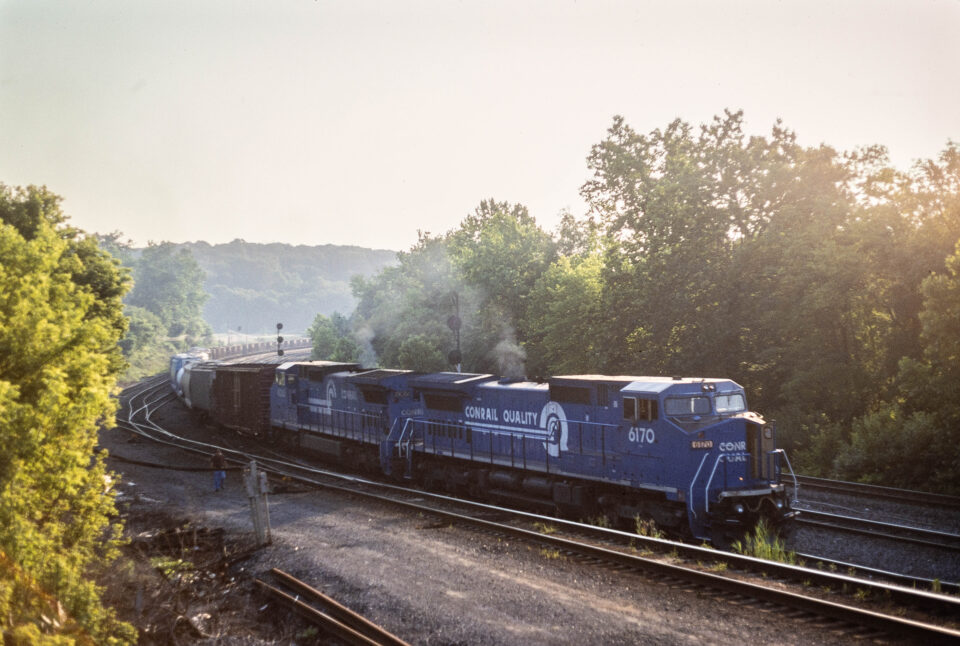
It would not be the last we saw of those two units. They came back east a few hours later as manifest ALOI-6 at 9:05, running through CP-Bethlehem — the same power making the return trip.
Back to CP-Burn
We shifted back to CP-Burn on the Reading Line, which turned out to be the right call. The Reading Line through Allentown was busy in the morning hours, and we caught a steady stream of trains for the next few hours.
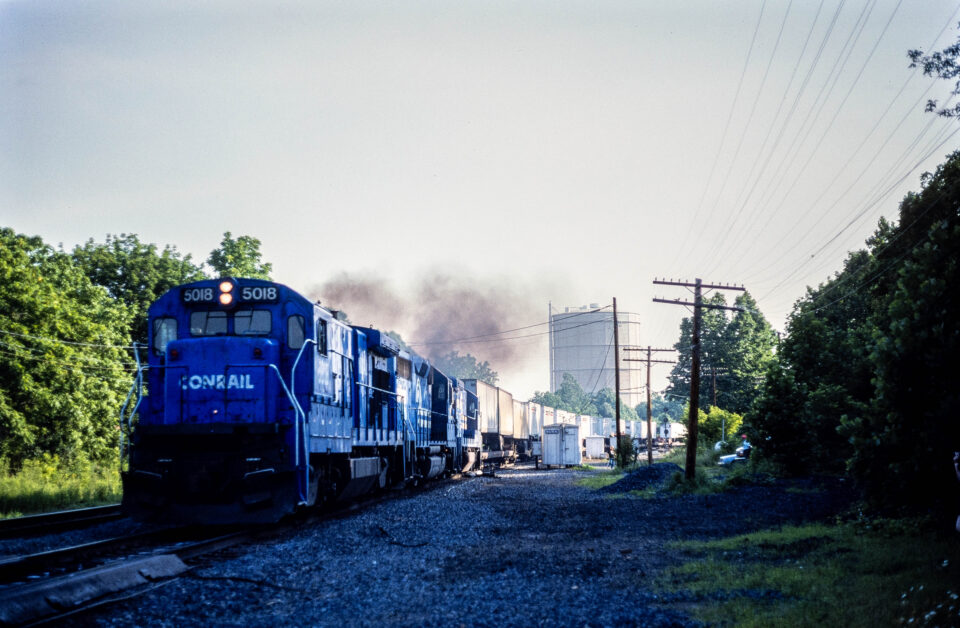
MAIL-9 came through at 7:52 with B36-7 No. 5018 on point, followed by a GP40 and another B36-7. The mail trains were reliable action on weekend mornings.
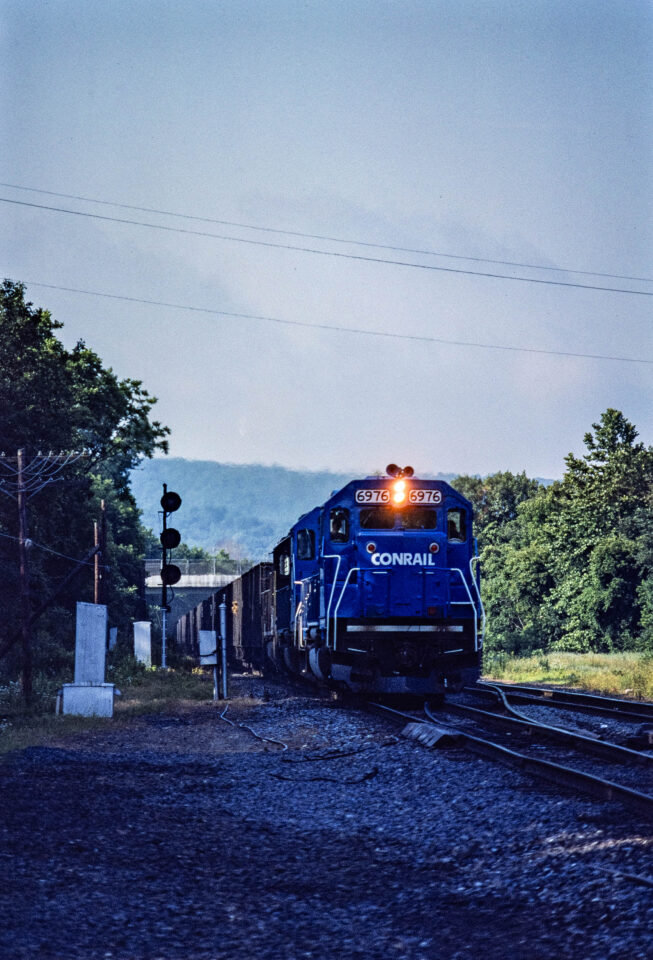
Then at 8:20, UBB-282 arrived with something a little more interesting on the point: SD40-2E No. 6976, a unit rebuilt at Altoona from a Pacific Rail Lines locomotive. Conrail’s SD40-2Es were a neat footnote — rebuilt from acquired or wreck-damaged units, distinguishable if you knew what to look for. Behind the 6976 was a standard SD40-2, and trailing both of them was an NS B23-7 No. 3961, lettered for the Southern but in NS paint — typical for NS units back then.
Soo Line Surprise at CP-Bethlehem
The best catch of the day wasn’t a Southern Pacific locomotive — it was a Soo Line one. We had made our way over to CP-Bethlehem by 9:35 when D&H train 266-25 came through with Soo Line SD40-2 No. 767 on point, wearing the white Soo Line paint scheme that was pretty common on the 265/266 trains to and from Oak Island Yard in Newark, NJ. CP Rail had purchased the Delaware & Hudson, and D&H’s trains were showing up with all manner of CP system power — Soo Line units were fair game. Behind the 767 was a GATX/GSCX leaser SD40-2.

Back to Burn for the Mid-Morning Rush
The Reading Line kept producing. Between 9:55 and 11:48, we caught six more trains at CP-Burn, and I got photos of most of them.
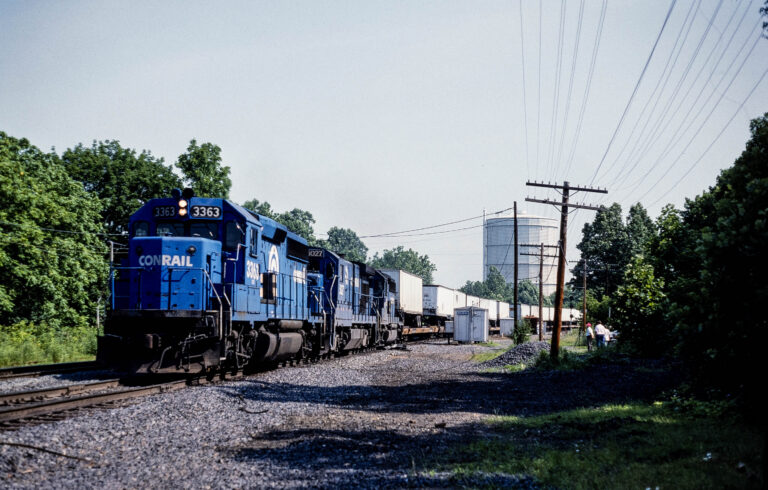
MAIL-3 at 9:55 — GP40-2 No. 3363 on point, two more units behind. A typical mail train consist.
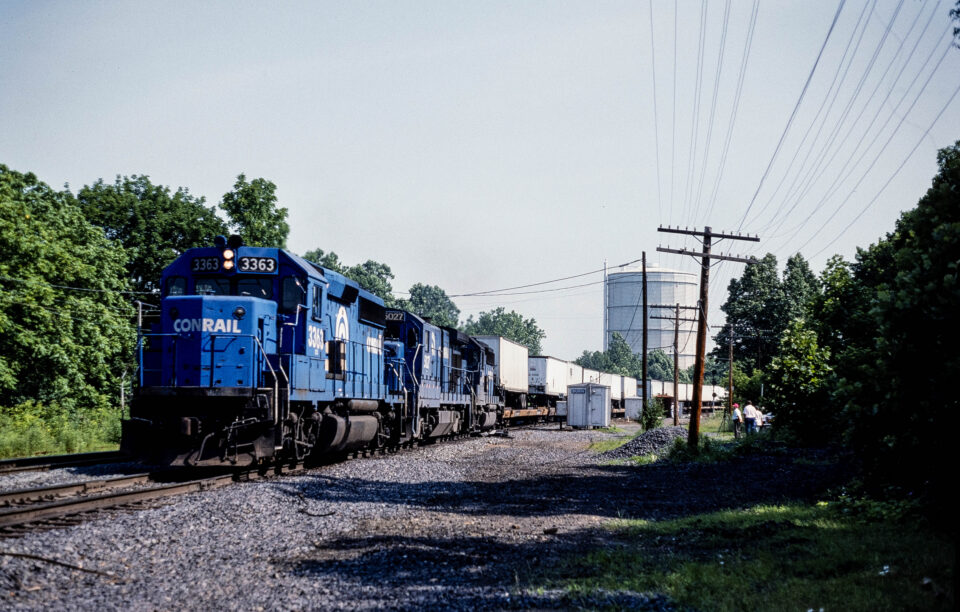
TV-212 at 10:15 — trailer train with SD40-2 No. 6419 leading an SD50 and a Norfolk Southern B23-7 No. 3979, another ex-Southern unit. This NJ-to-Atlanta Conrail-NS joint move regularly featured runthrough NS power. The 211/212 symbols would last another 20 years, well into the NS era.

Nest was PIAL-6 at 10:30 — SD50 No. 6777 on point with a GP40-2 and a C40-8W behind it.
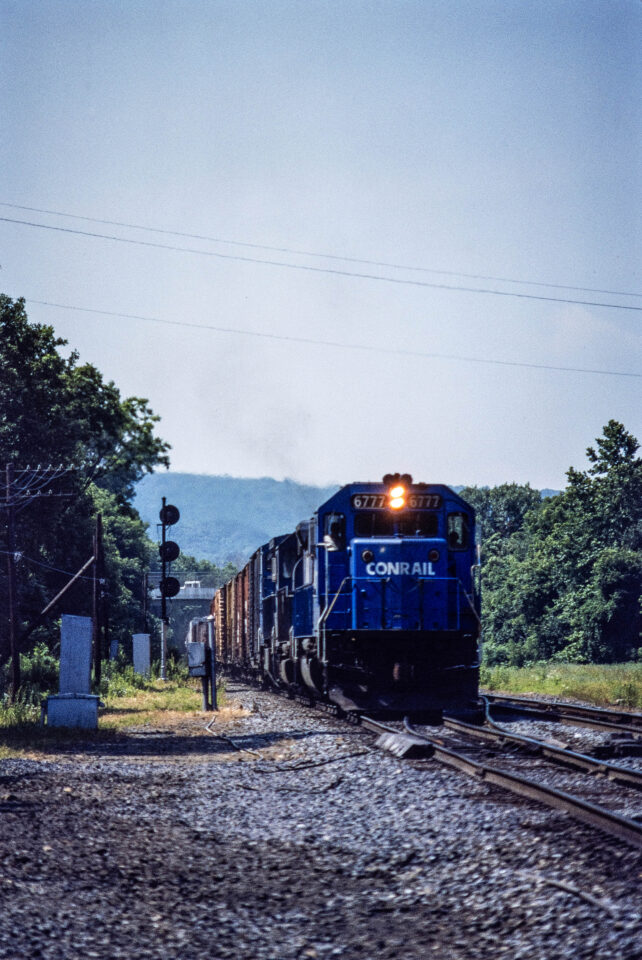
ENSE-6X at 10:55 — a second ex-Pacific Rail Lines SD40-2E showed up, No. 6983, behind the SD50 leader.
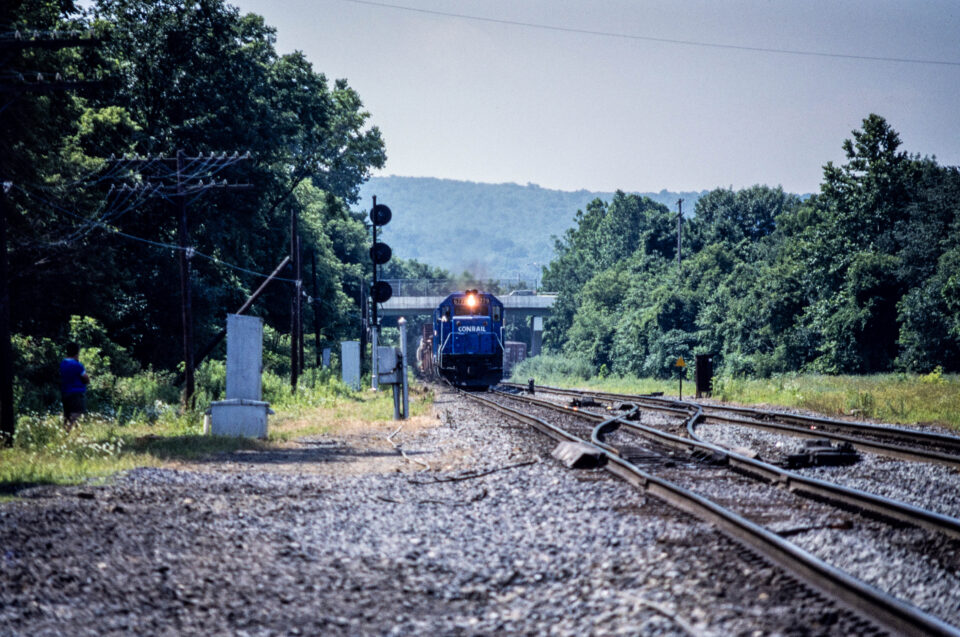
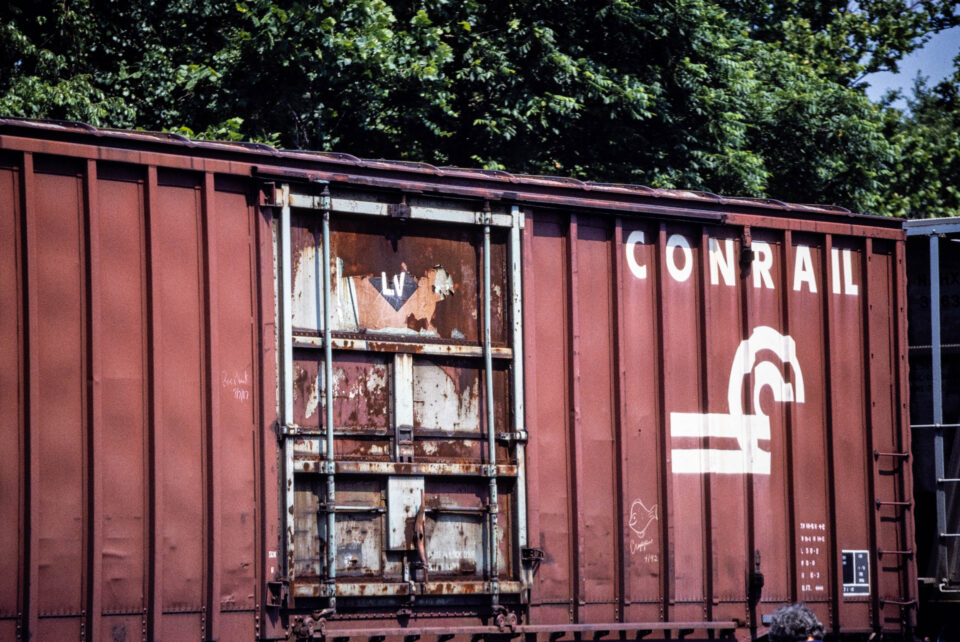
A “heritage” find on the ENSE, what looks like a Conrail X58 boxcar with a Lehigh Valley door on it.
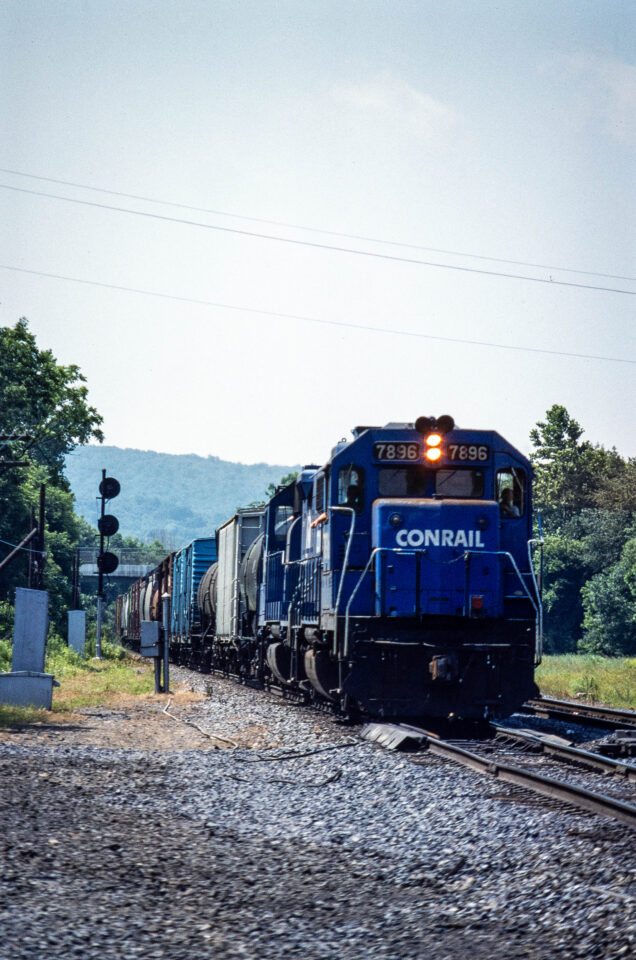
Next, what looks like an Alburtis/Chapman local returning to Allentown: WPAL-09 at 11:12 — GP38 No. 7896 on point with a GP38-2. Gotta love the EMD standard cabs.
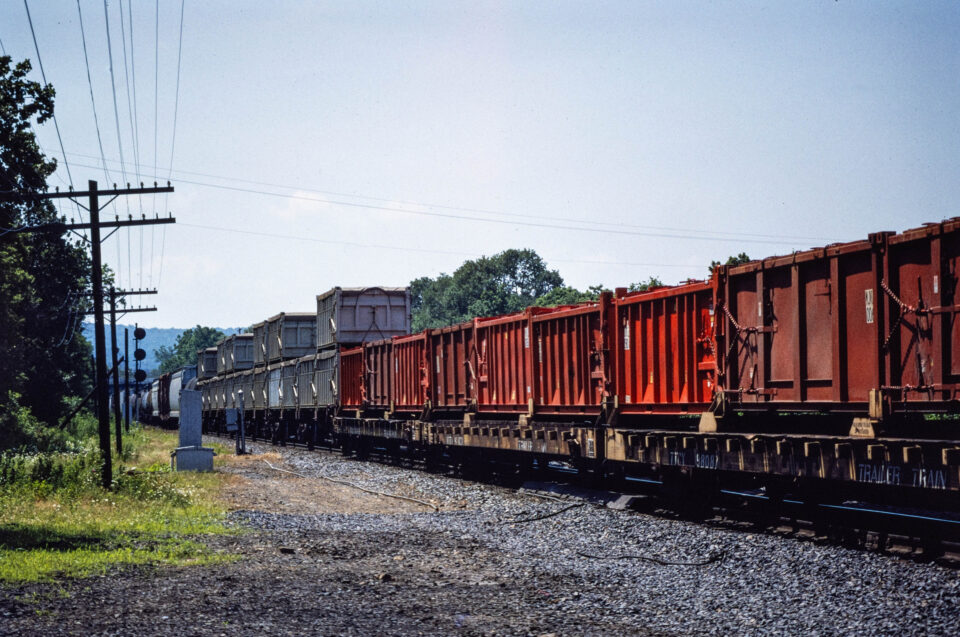
Yet another eastbound came along in the form of PIOI-6 at 11:48 — with a classic three-unit SD50/SD40-2/SD50 set, with No. 6805 leading.

Head out on the PIOI was a standard consist of municipal solid waste containers – the only “doublestacks” that could run this way until a few years later.
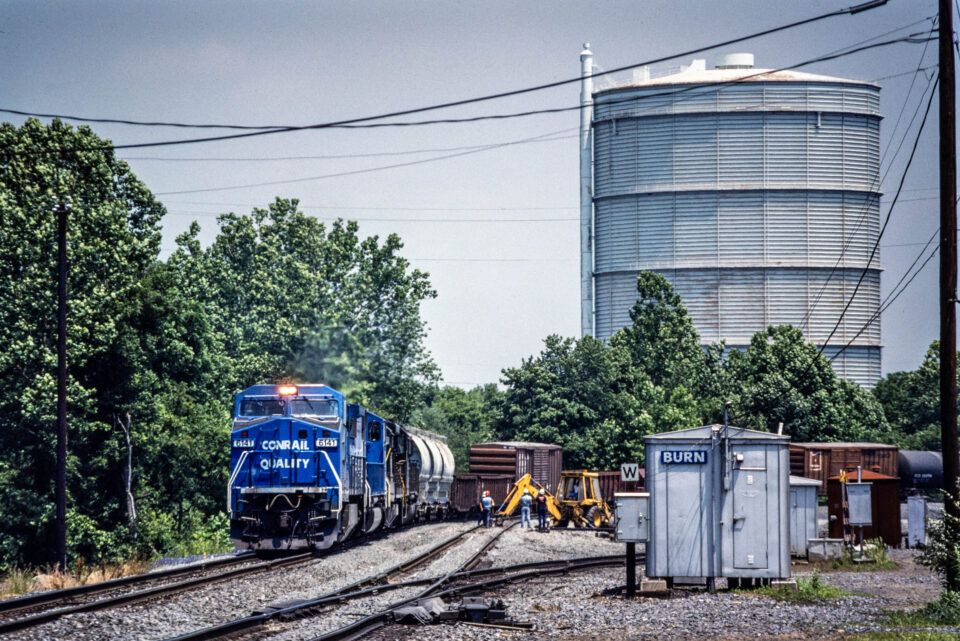
And then ALSR-6 at 12:03 closed out the CP-Burn session nicely: C40-8W No. 6141 on the point, SD60M No. 5559 second — and trailing both of them, two NS units lettered for predecessor roads: B36-7 No. 3815 in Southern marks and SD40 No. 1603 in N&W marks. Back when the “Southern Railway” symbol was still part of the train – ALSR later became updated to ALNS.
Over to Canal Park
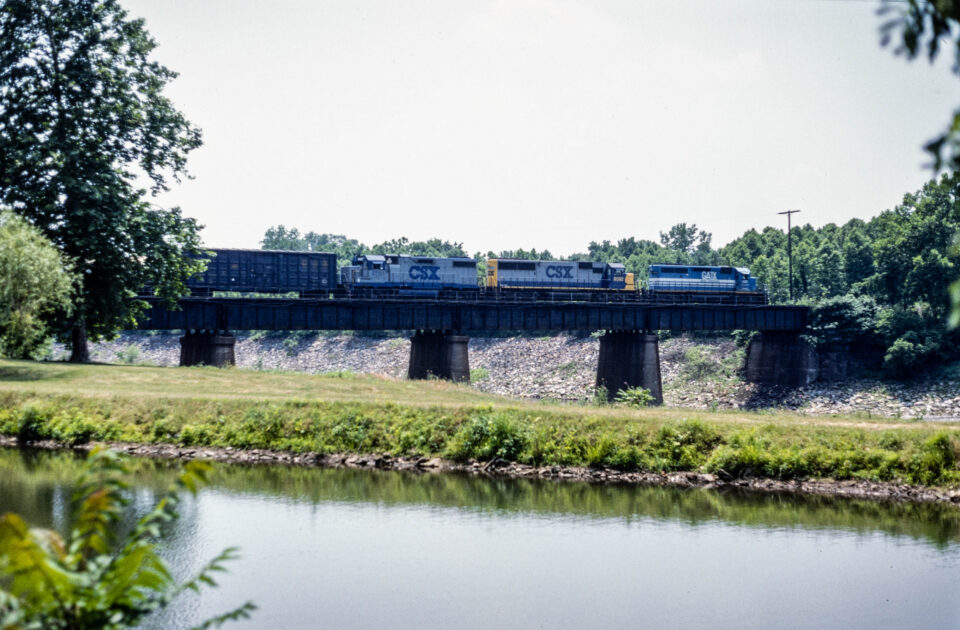
By early afternoon we had moved back over to the Lehigh Line. I imagine we hit the Burger King over on Susquehanna Avenue first… At CP-Ham at 1:30, the second D&H train of the day came through: DH272-26 with an all-foreign-power consist — GATX SD40-2 No. 7372 on the point, CSX SD50 No. 8592, and CSX GP38-2 No. 2711.
At 1:46, train ALCS-6 moved through CP-Allen — Conrail SD40-2 No. 6431 on point, but two CSX units trailing: CW40-8 No. 7771 and C40-8 No. 7546. Maybe we missed it, but no photo.
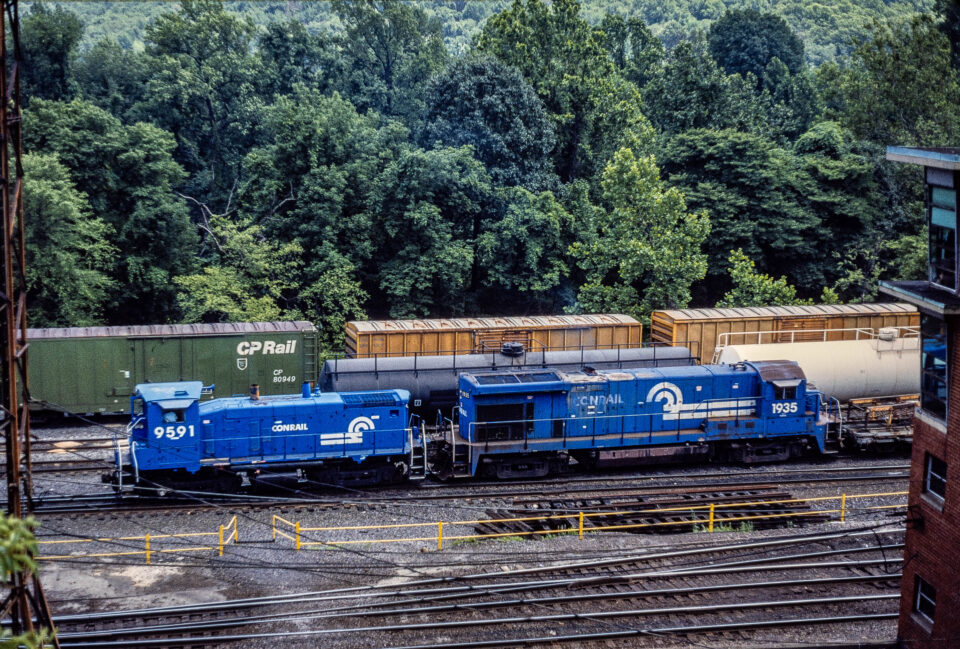
The day ended at CP-Canal: work train WOR-101 at 1:55, led by SW1500 No. 9591 and B23-7 No. 1935. Neat old power – that B23 looking rather “beat”, taking a rail train east.
We never did get that SP or DRGW unit. The OIEL showed up with two Conrail C40-8Ws that turned on an ALOI – so maybe we heard “OIAL” instead of “OIEL” on the radio. But with the various NS and CSX runthrough moves, Mail and TV trains, and two D&H trains, it’s hard to look back at the log and feel like we missed anything important. Seventeen trains in about eight hours, twelve of them photographed. Good times!
